Marta Puretz
Marta Puretz was born in Vienna on June 20, 1923. She came to Poland with her family as a child. She was the daughter of Dr. Jakub Puretz, a wealthy and well-known doctor from Dębniki, one of the districts of Krakow.
It is not entirely clear since when Marta Puretz cooperated with the Gestapo. However, after the attack on "[Cyganeria]", with numerous arrests, some of the detainees told others that they were busted because of Marta Puretz. The underground press also warned about her.
Her career as a collaborator was remarkably similar to Stefani Brandstatter's; beautiful, with blue eyes. She was famous for finding her victims on trams or just on the street. She also participated in provocations organized by the Gestapo. For example, in 1942, Marta Puretz came to Elżbieta Jasińska , who had contacts with the underground, asking for a [kenkarte]. Jasińska agreed to get her this document for PLN 2,000. Puretz was due to report to her in two days. However, when she came to her at the agreed time, the Gestapo came to her house, Jasińska was arrested, and then taken to Auschwitz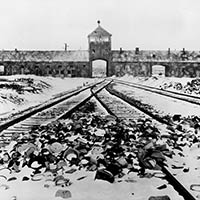 (German: Konzentrationslager Auschwitz) was a complex of over 40 concentration and extermination camps operated by Nazi Germany in occupied Poland during World War II and the Holocaust. It consisted of Auschwitz I, the main camp (Stammlager) in Oświęcim; Auschwitz II-Birkenau, a concentration and extermination camp with gas chambers and crematories; Auschwitz III-Monowitz, a labor camp for the chemical conglomerate IG Farben; and dozens of subcamps. The camps became a major site of extermination of Poles and the Nazis' Final Solution to the Jewish Question. . When Jasińska's brother-in-law later met Marta Puretz on the street without an armband, he ordered her arrested. However, she at the police station at ul. Franciszkańska, she presented a document of a Gestapo collaborator and was released. She threatened Jasińska's brother-in-law that if he got in her way, she would throw him in.
Marta Puretz was a friend of Weininger's Salo, another informant. In collaboration with [Eric Vollbrecht] of the Gestapo and Oberscharführer [Franz Siech], she promised to travel abroad to about eighty rich Jews who had foreign documents, of course not for free. Then, in 1943, they were all taken to Jerozolimska Street and shot on the site of the former Jewish cemetery.
Many Jews from Krakow tried to get to Hungary illegally - it was relatively safe there until the German occupation. And since many Jews came from Kraków and they all knew each other, it made the activity of informers easier. Also Stefania Brandstätter in 1944, thanks to Körner, was transferred to Hungary, it seems, to investigate the local environment.
Marta Puretz also operated under a different name - Maria Panecka. The news was that she had come legally to Hungary with Aleksander Ferster, also a Jewish informer. In the end, Marta Puretz was arrested, but during the occupation of Hungary by the German army, she was released from prison and immediately established contacts with Vollbrecht from Krakow. In Hungary, Marta Puretz not only dealt with the identification of Jews in the street, but also assisted during the arrests and searches in the homes of the suspects.
Dr Zofia Krzemień , a former employee of the Polish embassy in Vienna, was forced to work as an interpreter after her arrest by the Germans in Budapest at the end of the war. She saw Marta Puretz moving freely in Gestapo offices, carrying personal files and reports. According to Zofia Krzemień, Marta Puretz was considered one of the best collaborators of the Gestapo.
Marian Faber , a Krakow Jew, was arrested on a street in Budapest by an informant named Salo Weininger, whom he knew from Krakow. Weininger informed the Gestapo officers that Faber had escaped from the prison in Montelupich and that he was "smuggling Jews". When Faber's sister reported to Marta Puretz to negotiate her brother's release from custody, she immediately notified the Gestapo. Faber's sister was sent to Auschwitz. Seeing that the arrest was threatening the entire family, Faber fled. Unfortunately, at that time, the mother, brother and brother-in-law, not knowing about their sister's arrest and Faber's escape, brought the ransom. They were arrested and also sent to Auschwitz. Faber's mother died on December 9, 1944, and his brother in Gusen II on April 24, 1945. Sister and brother-in-law lived to see liberation in Auschwitz.
After the liberation of Budapest, Marta Puretz was searched for. She was found in the village of Tura, near the city of Hatvan in Hungary, and arrested there. She had with her documents in the name of Marta Hercz. During the interrogation, she admitted to working with the Gestapo and was sent back to Poland, but escaped during the transport. According to information from 1946, Marta Puretz was in France in Besançon under the name of Marta Hercz. This message was provided by the French consul in Krakow.
Witold Mędykowski "Przeciw swoim. Wzorce kolaboracji żydowskiej w Krakowie i okolicy"