Roman Romkowski
Roman Romkowski born Natan Grünspan-Kikiel (1907 – 1965), son of Stanisław and Maria Blajwajs, was a Polish communist official trained by Comintern in Moscow ("School of Lenin"), who settled in Warsaw, Poland, after the Soviet takeover, and became second in command (the deputy minister) the Ministry of Public Security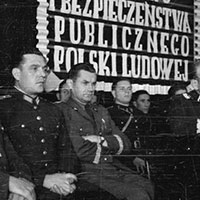 Ministry of Public Security (UB, polish: Urząd Bezpieczeństwa) - secret police, intelligence and counterintelligence agency operating during the communist era of the Polish People's Republic. Identified with communist crimes; murders and bestial torturing of those fighting for independent Poland. during the late 1940s and early 1950s. Along with several other high functionaries including Anatol Fejgin, Józef Różański, Julia Brystiger and the chief supervisor of Polish State Security Services, Minister Jakub Berman from the Politburo, Romkowski came to symbolize communist terror in postwar Poland.
He was a member of the Young Communist League of PolandKomunistyczny Związek Młodzieży Polski (KZMP) - a youth organization of the Polish Communist Party, active in the Second Polish Republic in the years 1922–1938. Its aim was to promote culture, education and sport among young people. She promoted the idea of fighting fascism and racism in a radical and decisive way, and strove to introduce a communist system in Poland. In 1933, it had 15,000 members, most of them of peasants. After the activists of the Polish Communist Party were murdered by the NKVD in the Soviet Union during the "great terror" period, the KZMP also ceased its activities., and later KPP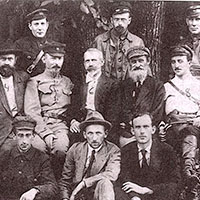 Communist Party of Poland (KPP, polish: Komunistyczna Partia Polski) – a communist party operating from 1918 to 1938. in Kraków. In 1930 he went to Moscow as a delegate to the 5th Congress of the KPP, after which he remained in the USSR. He studied at the Communist University of National Minorities of the West in Moscow. In 1936 he was sentenced to 7 years in prison for communist activities. After the outbreak of World War II, he made his way through the Soviet occupation to Brest. From 1941 in the USSR, he fought in the Soviet partisan unit "Brigade im. Stalin ”in Belarus.
In 1944 he took the position of an officer in Ministry of Public Security. In 1947 he interrogated the Captain Witold Pilecki in the 10th Pavilion of the Mokotów prison (Romkowski's handwritten notes are on the interrogation reports).
In 1949 he was appointed Brigadier General of Public Safety. He was a member of the Security Committee of the Central Committee of the Polish United Workers' PartyThe Politburo (abbreviation for Political Bureau) of the Polish United Workers (Communist) Party (PUWP; Polish: Polska Zjednoczona Partia Robotnicza, PZPR) was the chief executive body of the ruling communist apparatus in Poland between 1948–1989. Nearly all key figures of the regime had membership in the Politburo. The Politburo of the PUWP typically had between 9-15 full members at any one time. Usually, several alternate (or candidate) members were also elected to the Politburo, but unlike full members, alternate members did not possess full voting rights. , which supervised the apparatus of Stalinist repression in Poland. He personally conducted a brutal investigation against Szczęsny DobrowolskiSzczepan (Szczęsny) Dobrowolski (born Feliks Zamieński) (1914 - 1961) - communist activist, journalist, member of the management of the Radio Bulletin Group, co-founder of the Liberation Fighting Union (a communist underground organization fighting against Germany), officer of the People's Army, Warsaw insurgent. In the fall of 1949, he was arrested and imprisoned on fabricated charges. Released and rehabilitated in 1956. for "right-wing nationalist deviation". In fact, it was only about the contacts that Szczęsny had with Alfred JaroszewiczAlfred Karol Jaroszewicz ps. "Turczyński", "Zygmunt", "Fat" (1902-1981) - Polish officer, politician, participant in the Polish-Bolshevik war. He was active in the ranks of the Liberation Fighting Union (a communist underground organization fighting against the Germans), later the Home Army. Acting in a double role, he penetrated the structures of the General Headquarters of the People's Guard and its intelligence. He took part in the investigation, infiltration and combating of left-revolutionary movements., a high-ranking communistic party official who was active in the structures of the Underground State during the German occupation.
Szczęsny did not know what they were accusing him of. He knew it was something terrible, but the Gestapo did not come to his mind. They gave him a pencil and paper and told him to write. What to write, he asked. The whole truth. He wrote, they said that he was hiding something important, they beat him and gave him new paper. He was still hiding. What, he asked. Your crimes. What crimes I am after I was doing? You know very well, they said, beat him and gave him a new piece of paper. After months Szczesny went mad. He confessed. He has committed a crime. He chose the one that was the most terrible.

Although the personal torture of a prisoner was proven to him only once - precisely in the case of Dobrowolski, it was common for the officers subordinate to him to be manipulated in such a way that they also turned into executioners. When he was arrested in 1956, the commission that investigated party responsibility for breaking the rule of law wrote in a report:
Romkowski, Różański, Fejgin created a special system of conducting the investigation, consisting in the fact that most often young, inexperienced investigators were not privy to the entire investigation, and received from their superiors predetermined fragmentary questions and had the task of conducting research only on circumstances related to these questions and obtaining evidence in accordance with the preconceived ideas. This situation created a fertile ground for the extensive use of illegal methods by the Security investigation apparatus, consisting in physical and moral violation of a person using all means of physical pressure, pressure and blackmail. Suspects were presented to investigators as the most fierce, cunning and dangerous enemies who would not admit their grave crimes. This is how Romkowski and Fejgin set up the investigative apparatus.
In 1956 he was sentenced to 15 years in prison for torturing detainees and copying beriowszczyznaBeriowszczyzna - colloquially the period of "great terror" in the Soviet Union in the years 1938-1953. Then the Soviet apparatus of repression was led by Lavrenti Beria. methods in security agencies, which was contributed to, among others, by testimony of his associate Bronisław SzymańskiBronisław Szymański - an officer of the Soviet and Polish secret services. By the Soviet authorities, he was seconded as a soldier to the 1st Infantry Division Tadeusz Kościuszko, then directed to the NKVD course. Member of the UB group of Gen. Roman Romkowski, investigator in the UB Investigation Department. He was interrogated by the KGB as to the course of his service in the UB in Poland, and the materials from this interrogation were forwarded to the Polish side, serving, inter alia, to prepare a report on abuses in the Stalinist security apparatus in Poland.. He was released in 1964 as a result of the application of the law of grace. After his death, he was buried in the Powązki Military Cemetery.