Józef Unszlicht
Józef Unszlicht was born in 1879 in Mława, to a polonised Jewish family. In 1900, he joined the Polish Marxist organisation SDKPiL The Social Democracy of the Polish Kingdom and Lithuania - a Polish Marxist political party active at the turn of the 19th and 20th century. Initially it was called Social Democracy of the Polish Kingdom and since 1900, after extending its activity to Vilnius region - Social Democracy of the Polish Kingdom and Lithuania. Since April 1906 it was an autonomous section of Social Democratic Party of Russia, but it kept its ideological and organizational independence.. He was imprisoned for communist activities, and eventually exiled to Russia. In 1906, he was already a member of the SDPRR. He took part in the Bolshevik coup (October Revolution) in Petrograd - here he found a place at Lenin's side. Later he became a member of the Revolutionary War Council and the ChekaCheka (All-Russian Extraordinary Commission for Combating Counter-revolution and Sabotage / Speculation and Abuse of Power) - the acronym for the secret police in Soviet Russia from 1917 to 1922. From this name came the colloquial term for its officers - Chekists (Chekista); today it often refers also to officers of the state security organs such as KGB, FSB and SWR. The Cheka used methods such as hostage-taking and mass executions on an unprecedented scale. Machine guns were used for mass executions of counter-revolutionaries. So many death sentences were handed down in Petrograd that convicts were tied in pairs, loaded onto wooden barges in the evenings, taken out into the waters of the Gulf of Finland and sunk there. The establishment of internal order often involved mindless, appalling atrocities by the Cheka. College, and co-organised the Red Army units in Lithuania and Belarus. He was a co-founder of the Polish Red Army
 .
.
During the Polish-Bolshevik WarThe Polish-Bolshevik War (1919-1921) - war between the reborn Republic of Poland (the Second Republic of Poland) and the Russian Federative Soviet Socialist Republic (RFSRR), aiming to conquer European states and turn them into Soviet republics, in accordance with the ideology, political doctrine and political programme of the Bolsheviks, described as "revolution from outside". he co-founded the puppet Provisional Polish Revolutionary Committee Provisional Polish Revolutionary Committee (TKRP), Polrewkom (Russian: Польревком) - a political formation created by the Bolsheviks in 1920 in Smolensk to serve as the communist authority in the areas of the Second Polish Republic occupied by the Red Army during the 1920 summer offensive in the Polish-Bolshevik war.. Here he dealt with party matters, giving priority to his more "distinguished" colleagues - Julian Marchlewski
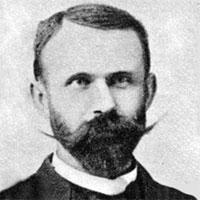 Julian Baltazar Józef Marchlewski (1866 – 1925) - Polish communist politician, revolutionary activist, publicist and chairman of the Provisional Polish Revolutionary Committee. Socialist press editor, columnist and publisher. and Feliks DzerzhinskyFeliks Edmundowicz Dzerzhinsky (1877 - 1926) - Polish and Soviet revolutionary and politician. After the Bolshevik coup he was the organiser of the Soviet security services. From 1917 he headed the Cheka, GPU and OGPU. Due to his co-responsibility for political repressions during the Red Terror he became known as Iron Felix, Bloody Felix or Red Executioner..
After returning to Moscow in 1921, Unszlicht was promoted to deputy head of the [Cheka]. He was responsible for intelligence and the functioning of spy networks in Western countries. He created, for example, a fictitious centre of anti-Bolshevik opposition in order to infiltrate and break up its real structures. Moreover, he initiated the construction of Solovetsky Special Purpose CampThe Solovetsky special-purpose camp SLON (Russian: Solovetskyi Lager Osobovo Naznaczeniya) became a testing ground for developing the principles of a functioning gulag system. The camp was set up on an archipelago of islands in the White Sea. The authorities took over the old churches and monastery buildings scattered around the islands one by one. The poor hygienic conditions, overwork and malnutrition led to the spread of diseases, especially typhus. According to some calculations, the death rate was very high - every year between one quarter and half of the prisoners died of hunger, typhus and other diseases.. He was Dzerzhinsky's deputy until 1923, holding many lucrative posts in the following years, depending on the demands of the Soviet party.
Unshlicht was arrested in 1937, during Stalin's Great TerrorThe Great Purge or the Great Terror was Joseph Stalin's campaign of political repression in the Soviet Union that occurred from 1936 to 1938. It involved large-scale repression of the peasantry; ethnic cleansing; purges of the Communist Party, government officials, and the Red Army; widespread police surveillance, suspicion of saboteurs and counter-revolutionaries, imprisonment, and arbitrary executions. Millions of innocent were mordered. Historians estimate the total number of victims of the Stalinist repression in 1937–38 to be between 950,000 and 1.2 million., on the eve of Polish Operation of the NKVDPolish Operation of the NKVD - directed mainly against the Poles, the so-called national operation of the NKVD, carried out on Soviet territory in the years 1937-1938 in the period of great terror. According to the documents of the NKVD, 139,835 people were sentenced, out of which no less than 111,091 Poles - citizens of the USSR - were murdered with a shot in the back of the head, and 28,744 were sentenced to stay in gulags. The sentences were carried out immediately. The NKVD Polish operation was one of the so-called NKVD nationality operations, which targeted the representatives of other nations and ethnic groups living in the Bolshevik state - Russians, Ukrainians, Belarusians, Jews, Finns, Latvians, Greeks, Bulgarians, Chinese, Koreans, Germans and others. In comparison with other national operations of the NKVD, the "Polish operation" was distinguished by the exceptional scale of repression, brutality and severity. Murdered Poles accounted for 44.9 percent of all victims of NKVD national operations. - the NKVD could thus boast of having arrested the highest-ranking Pole in Soviet power. He was accused of acting with the aim of liquidating Soviet power, economic diversion, "sectarianism" or infiltration. Unszlicht is said to have pleaded not guilty to the charges to the very end. Unszlicht was shot at the NKVD facility Butowo-Kommunarka.