Lazar Kaganovich
Lazar Moiseyevich Kaganovich was born in 1893 in the hamlet of Kabany (now: Dibrova, Ukraine) into the family of a small Jewish cattle trader. He was a Soviet politician, member of the highest state and party authorities of the USSR, Hero of Socialist Labour. One of Stalin's closest associates.
Kaganovich was behind the collectivisation and depopulation (including the arrest and exile of the population) of Ukraine, the northern Caucasus, central Russia and parts of Siberia. In these areas he acted as Stalin's special representative. He thus became the architect of the Great Famine as an instrument of repression against peasants resisting the collectivisation of agriculture. The Great Famine claimed between 6 and 10 million lives, at least 3.3 million of them on Ukrainian territory. It led to horrific acts such as cannibalism (including of one's own children) and trade in human meat.
As Moscow's first secretary from 1930 to 1935, he initiated the reconstruction of the capital, including the destruction of a number of Moscow's outstanding monuments, above all the Church of Christ the Saviour The Cathedral of Christ the Saviour (Russian: Хра́м Христа́ Спаси́теля) is the largest Orthodox church (sobor) in the world, located in Moscow on the banks of the Moskva River, near the Kremlin. The main church of the Russian Orthodox Church. and the monastery of the Icon of Our Lady "Suffering" from 1654.
Repeatedly one of the main implementers of Stalin's "purges" both inside and outside the party. Stalin called him the "Iron Lazar". He initiated the phenomenon of Stalinism.
Everyone talks incessantly about Lenin and Leninism, yet Lenin died long ago.... Long live Stalinism.
Co-responsible for the Katyn massacre, he signed the decision to execute a total of 25,700 people from among the group of Polish military and civilians in the NKVD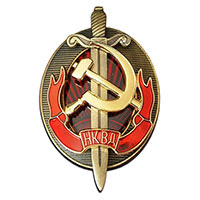 People's Commissariat of Internal Affairs of the USSR (NKVD, russian: Наро́дный комиссариа́т вну́тренних дел) – a central state organ existing under this name in the years 1917–1946. He became a symbol of all crimes committed by the Soviets in the public consciousness. facilities. According to this decision, 21 857 people were murdered in the spring of 1940.
He died in 1991 in Moscow.